The universe, at 1:1 scale,
in your browser
Fly from a real planet's surface to orbit and back, with nothing standing in for the real thing — one continuous universe, built from real NASA elevation data, running in a browser tab.
What it is
Exokosm is a real-time, 1:1 scale planetary rendering engine. From a planet's surface to orbit, then out to the galaxy at large.
Your graphics card redraws the ground itself, every frame, in more detail the closer you get — down to individual rocks — with nothing swapped out and no loading screen along the way. Camera math is built to stay accurate whether you're a metre off the ground or a light-year from home.
It is free to play and needs nothing installed. If your browser supports WebGPU, it runs.
Real worlds, real data
These are not invented planets
Where a spacecraft has mapped a surface, Exokosm renders that survey: elevation models and imagery from NASA and USGS, at the body's real radius. Where coverage runs out, the gap is filled procedurally and documented rather than hidden.
Alongside the real planets above, Exokosm also keeps a made-up test world — no real data behind it, just a place to try new terrain, lighting and ring ideas before they're used anywhere real. Shown honestly for what it is: invented, not surveyed.
Mars
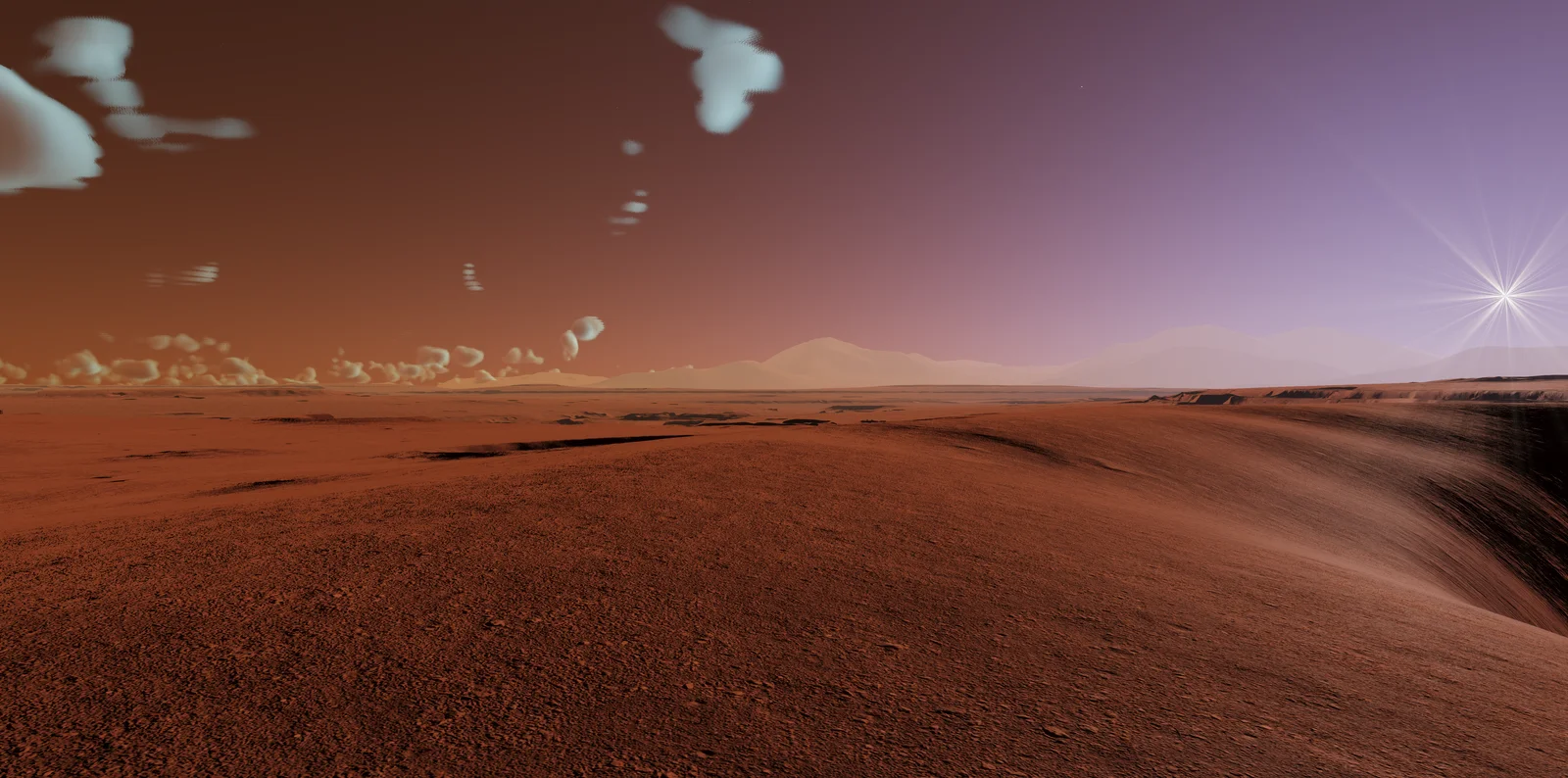
MOLA elevation · colour mosaicStanding on the real surface of Mars — dust, dunes, and a sky hazy with real Martian dust.
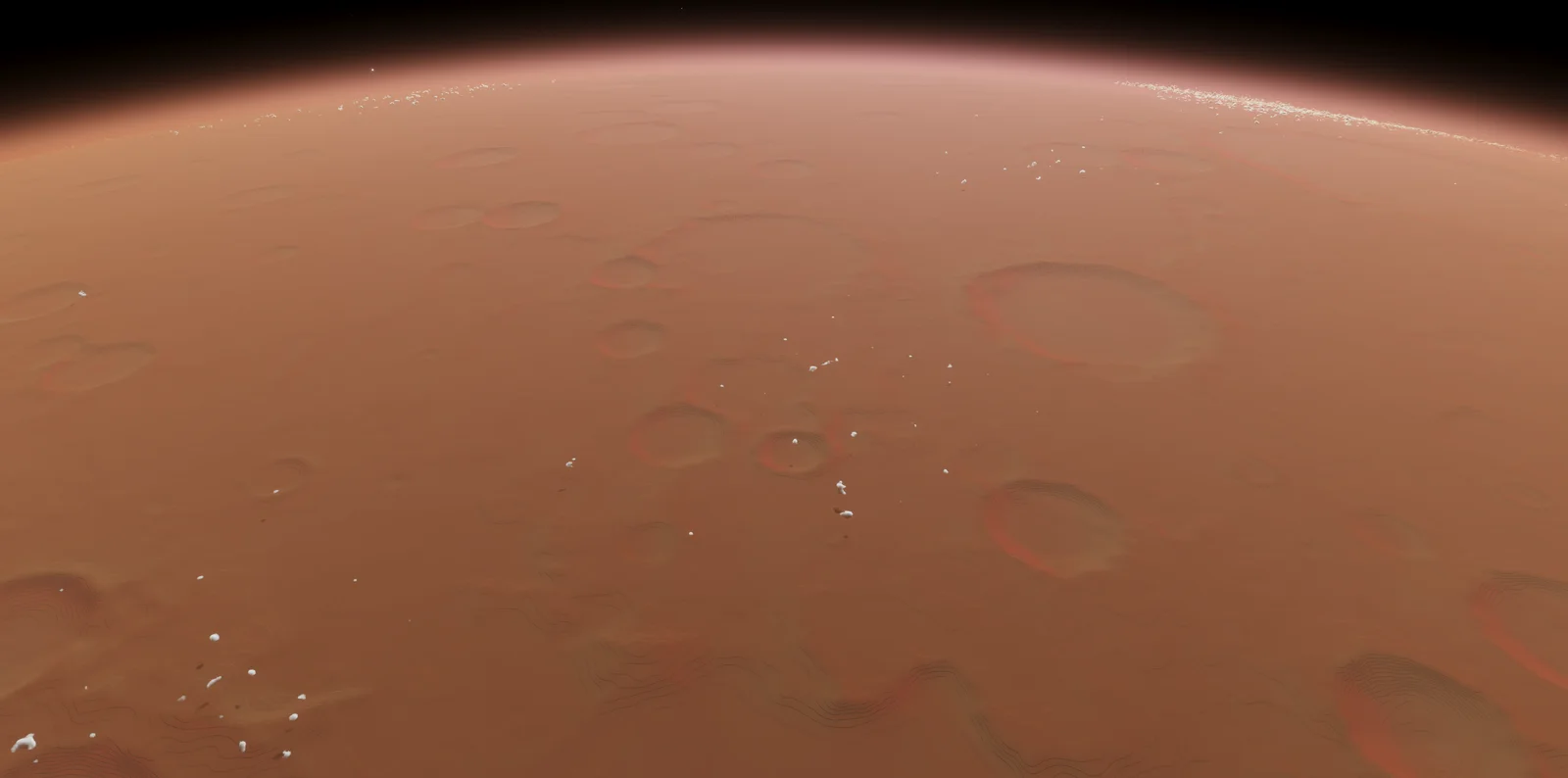
Mars, from orbit
MOLA elevation · colour mosaicThe same real Mars, seen from orbit — craters, a polar ice cap, and its thin atmosphere at the horizon.
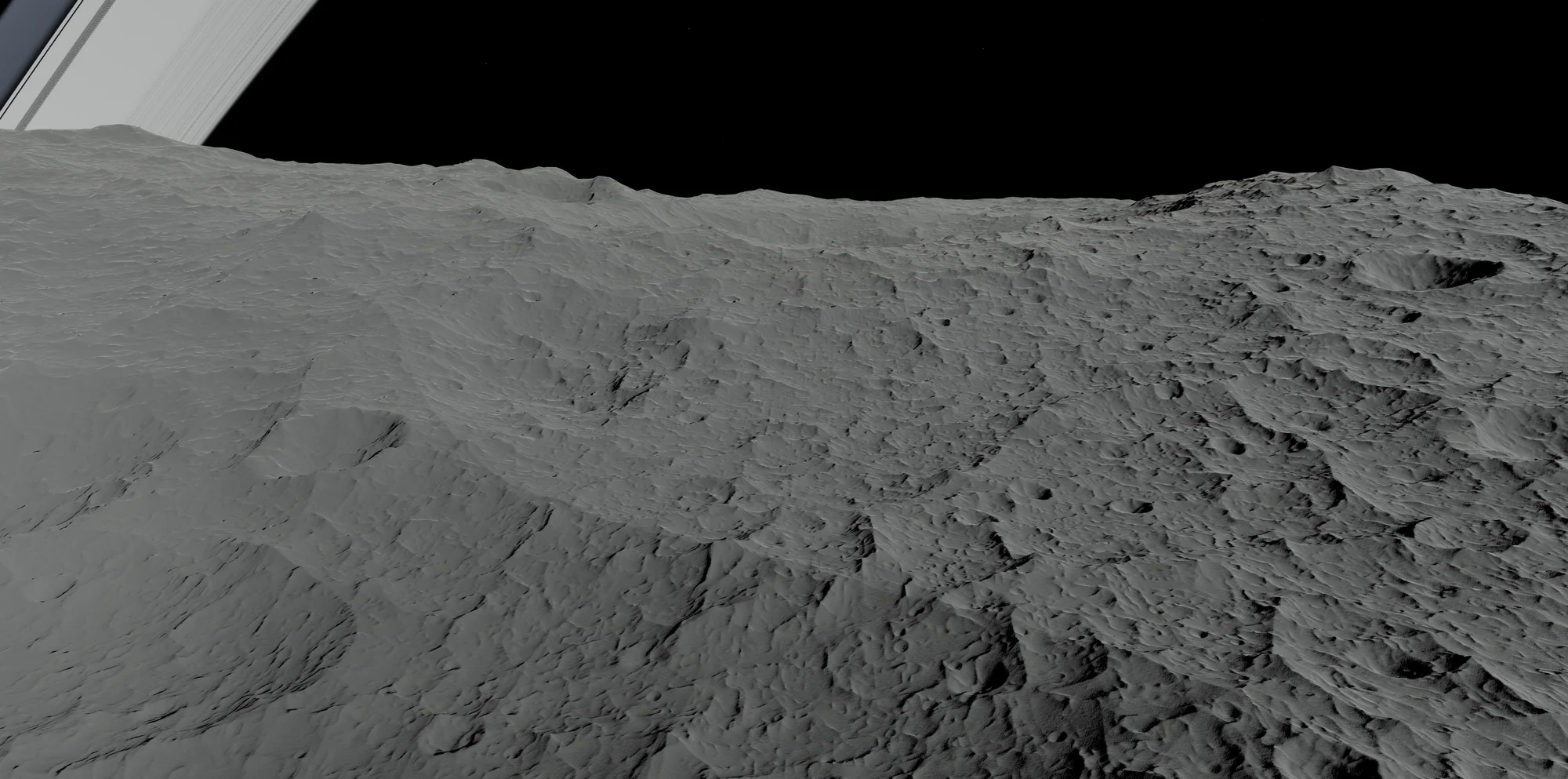
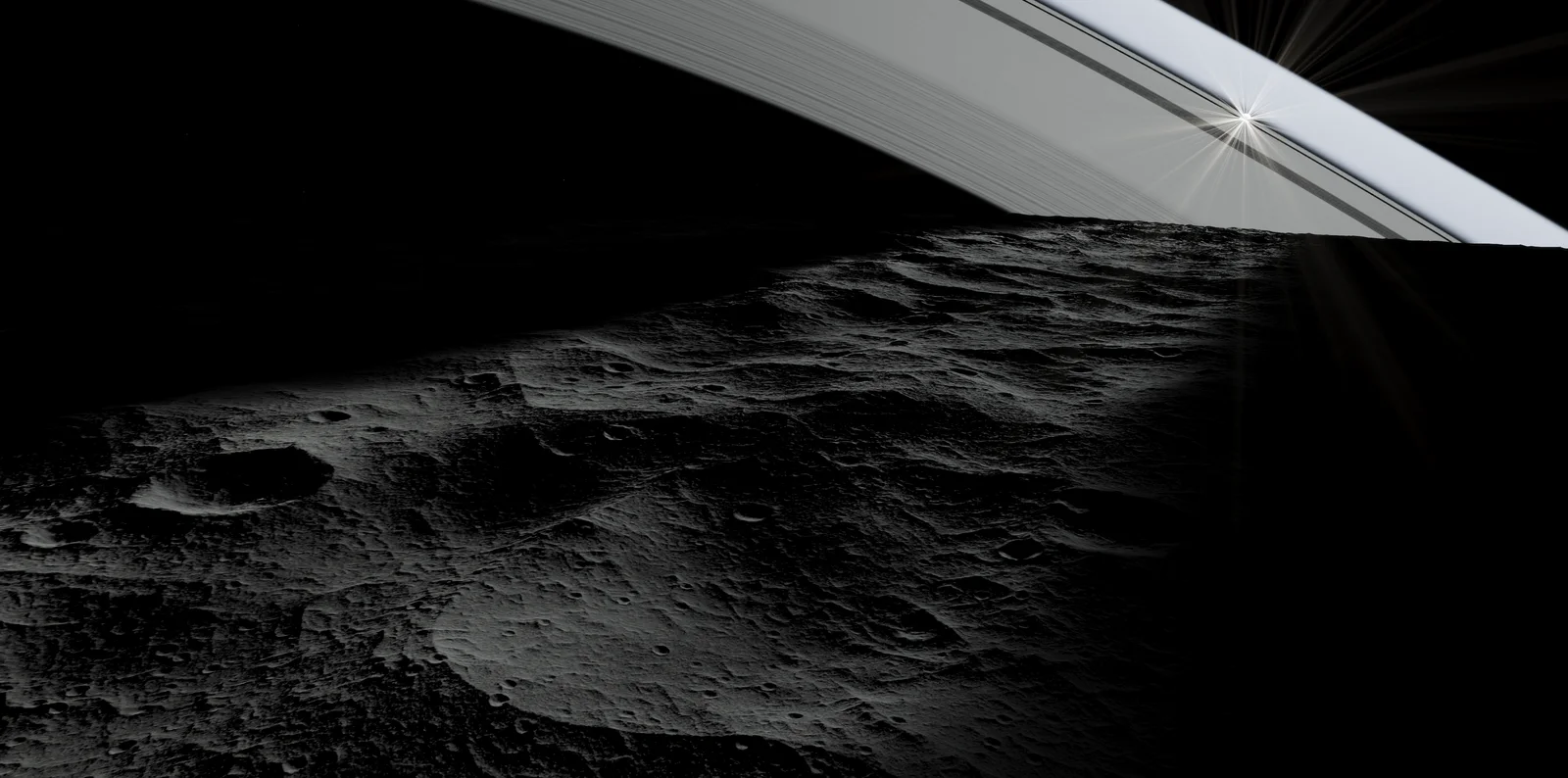
A star shining through a made-up ring system, above a crater rim that was never a real place.
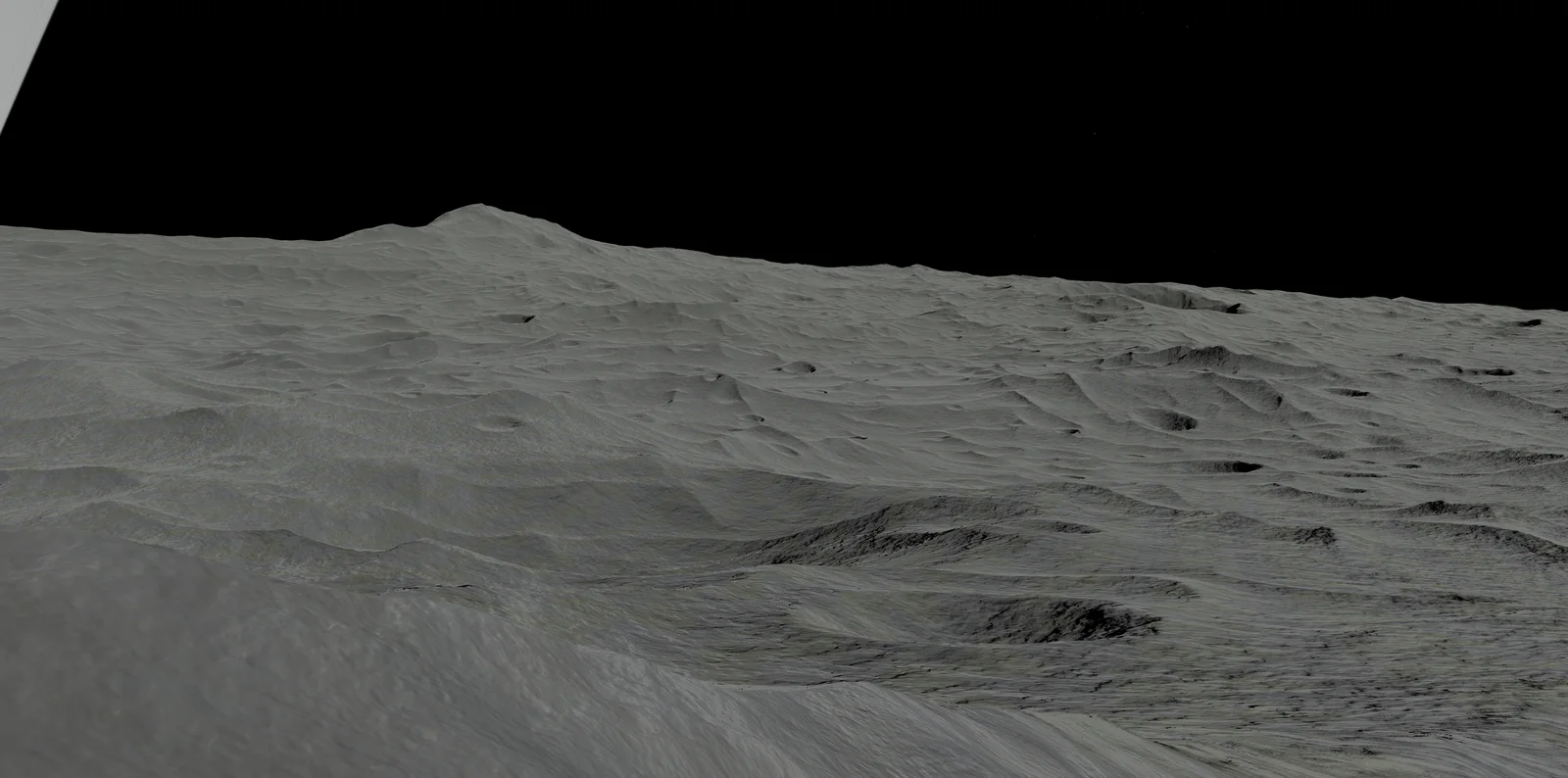
A jagged, invented ridge in front of the same fictional rings, seen from lower up.
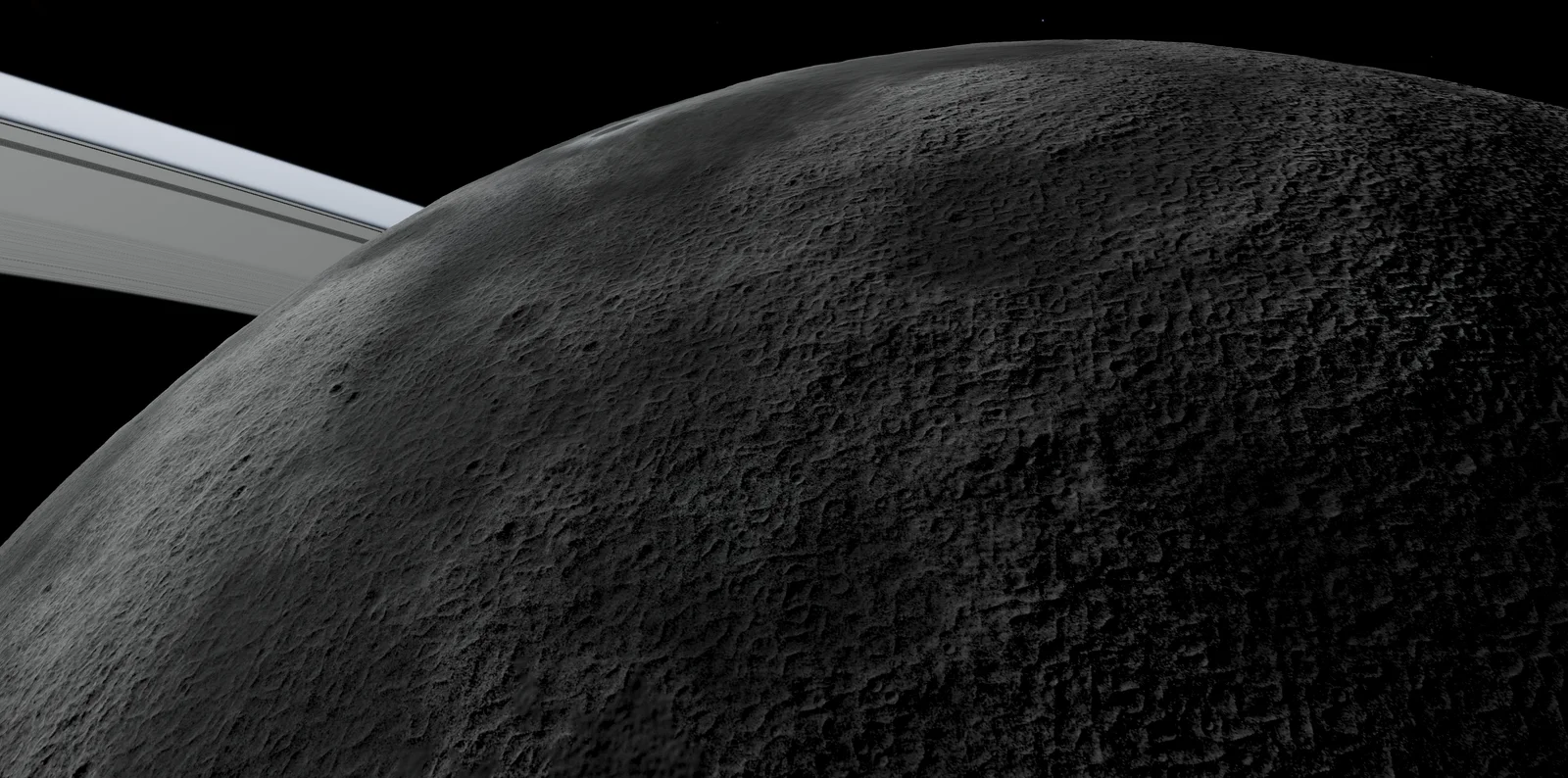
The curved edge of the test moon, with the rings passing behind it.
Rock and crater detail down to the centimetre — all made up, with no real elevation data behind it.
Mercury, at its real distance from the Sun and its real size — but the surface is still a placeholder; real elevation data for it hasn't been added yet.
The Sun's system is modelled with 30 bodies — the Sun, eight planets, Pluto, and 20 major moons on their real orbits, including Triton going the wrong way round Neptune.
What it does
Built to survive being looked at closely
Terrain with no seams, ever
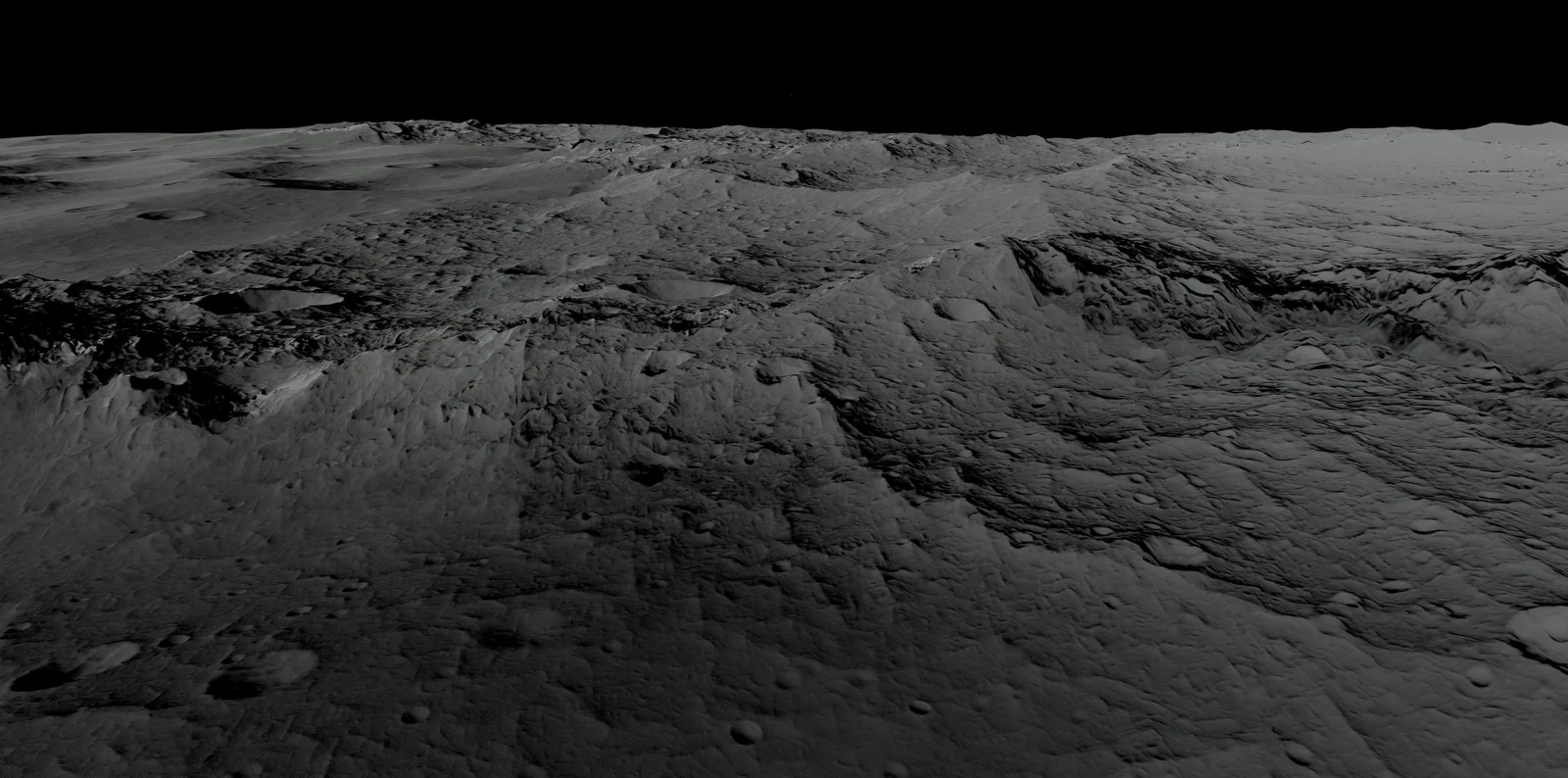
Fly from orbit to the ground with no loading screen. The surface keeps redrawing itself in finer and finer detail the closer you get — all the way to individual rocks — with no cracks or sudden pop-in.
Light and shadow that feel real
Every patch of ground reacts to light the way real rock and dust do, casting its own shadow — including the bright halo you'd see around your own shadow while standing on the Moon.
Real skies, real clouds
The sky scatters light the way Earth's really does, and on Earth the clouds follow real satellite weather imagery instead of a repeating texture.
Fly it yourself
Free flight in any direction, real gravity pulling you toward the ground, and real orbital mechanics if you switch to orbit instead.
Under the hood
The engine is the point, too
A quick look under the engine — the architecture, the precision work, and the decisions that did not pan out.
Floating-Origin Camera
OriginCamera keeps the GPU vertex shader at (0,0,0) each frame while accumulating absolute position in double-precision WorldDouble coordinates — no precision drift at 1:1 planetary scale.
GPU CBT Terrain LOD
A pool-CBT engine inspired by Benyoub & Dupuy (HPG 2024) — fully GPU-driven adaptive triangulation with screen-space error control, crack-free from orbit to ground.
WebGPU Render Pipeline
Frame Graph architecture with star ray-marching, single-scattering Rayleigh+Mie atmosphere, TAA, FXAA and ACES tone mapping. WebGPU required — no WebGL2 fallback.
Numerical Precision
Emulated double precision (df64) in the terrain decode keeps geometry crack-free at depths where 32-bit floats collapse — the difference between a planet and a puddle of artifacts.
Stellar Catalog
A declarative JSON catalog — the Sun, its planets and their major moons on real orbits, each with its own terrain and lighting profile. Past its edge, systems are generated from a real star catalogue, so a neighbour like Alpha Centauri is somewhere to fly to rather than a line in a file.
Before you start
What you need
Exokosm needs WebGPU, a newer graphics technology most browsers now support out of the box. There's no fallback for older browsers — the terrain relies on features only WebGPU provides.
Browsers
- Chrome / Edge
- 113+
- Firefox
- 141+ Windows · 145+ macOS
- Safari
- macOS / iOS 26+
Hardware
- Minimum target
- Ryzen 5 2400G · RX 580 8 GB
- Reference
- Ryzen 7 5800X3D · RTX 5080
The minimum row is the optimisation target, not a promise — that machine needs a lower render scale and detail level, both in the in-game settings, to stay comfortable at ground level.
Measure your own machine instead →Press kit
For press & creators
Everything needed to write about the project, in one place. Every fact and every screenshot on this page is free to use in articles, videos and posts about Exokosm.
Fact sheet
- Developer
- Benoit Podwinski (solo)
- Platform
- Web browser (WebGPU required, no WebGL2 fallback)
- Price
- Free
- Status
- Work in progress — v0.0.5
- Release date
- Unreleased; playable now in the browser
- Engine
- Custom WebGPU renderer on BabylonJS 9 + TypeScript
- Play
- exokosm.com/play/
Short description
Exokosm is a real-time, 1:1 scale planetary rendering engine that runs in a browser on WebGPU. It renders real worlds — the Moon, Mars, Earth — from NASA and USGS survey data, continuously from orbit down to ground level.
Longer description
Exokosm lets you explore planetary surfaces at any altitude, from ground level to orbit, with no loading screen in between. The whole planet is drawn fresh by the GPU every frame, redrawing itself in more detail the closer you get, with a camera built to stay accurate at any distance.
Where a spacecraft has actually surveyed a surface, Exokosm renders that survey rather than inventing one: lunar LOLA elevation and WAC reflectance, Mars MOLA, Earth's ETOPO1 including ocean depth, Venus radar, Pluto's partial New Horizons coverage. The Sun's system holds 30 bodies, including 20 major moons on their real orbits. Every surface casts its own shadows, and planetary rings only appear where they'd really form — casting the same banded shadow the Cassini probe photographed at Saturn.
It is free to play and requires no installation or account — a WebGPU-capable browser is the only requirement.
Every screenshot on this page is straight from the engine at full resolution — no compositing, no touch-ups. Click any of them to open the full-size version, or right-click to save.
Questions, coverage, or a bug worth writing about — the fastest route is contact@exokosm.com.
Go and stand on the Moon
It loads in a tab. Pick a world, fly down, and see how far you can push it before it breaks — then tell me where it broke.